
How much did the inhabitants of Ancient Rome and China earn in terms of modern money?
In ancient times, people had different priorities in life, different values and religious beliefs. But their basic needs were similar to ours - they needed to eat, dress and live somewhere. And all this required money. Scientists decided to find out how much the inhabitants of Ancient Rome earned on average. During the study, they even compared their income with what the Chinese received, who lived on the other side of the world. And you know what? The results were quite unexpected.

At the beginning of the 2nd millennium, the Roman Empire was the most powerful state in Europe and most of Asia. Its only real competitor could be the Chinese Han Empire. It was the incomes of the inhabitants of these two states that American scientists decided to calculate. To make the results closer and more understandable to us, the researchers converted ancient earnings into modern dollars. Now we can compare them with what we earn today.
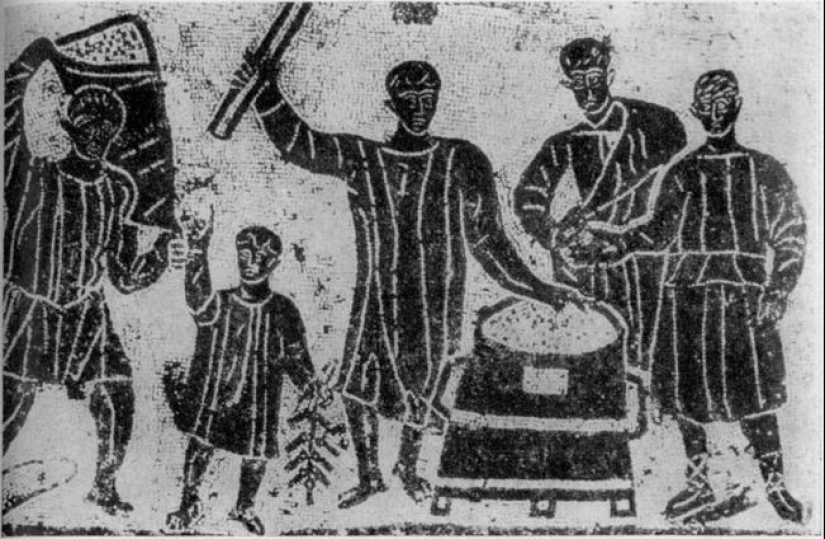
The scientists decided to compare the two empires at their peak. For Rome, it was 165 AD, and for the Han Empire, it was 2 AD. Of course, there were both very rich and very poor people at that time. But the researchers took the average income that most of the population had.
To conduct the analysis, the scientists chose a universal indicator - wheat. This product was highly valued both in Europe and in Asia. They calculated that the subsistence minimum per person per year was 333 kg of grain. This figure included not only the amount of food needed for sustenance (approximately equivalent to 250 kg of wheat), but also the additional amount of grain that was spent on purchasing non-food items. It was simply impossible to live without such things.

According to surviving historical documents, the gross domestic product per capita in Ancient Rome was approximately 750 kg of wheat. This was 2.25 times higher than the subsistence minimum. In the Han Empire, things were slightly worse: the average annual GDP per person was about 626 kg of wheat. This figure was only 1.88 times higher than the subsistence minimum. Thus, the inhabitants of the Roman Empire could afford more than their neighbors in Asia.
But it is well known that GDP does not show the real picture of the population's income. It is only a general indicator of the efficiency of the state's economy. But scientists have found a way to estimate the earnings of different strata of the population by correlating them with the subsistence minimum. It turned out that most Romans - or more precisely, about 70 percent - earned approximately 1.34-1.88 subsistence minimums. This is equivalent to 446-626 kg of wheat per person per year.

In the Han Empire, the bulk of the population were peasants who lived off their own farms. The vast majority – about 75 percent – could count on an income of 1.03–1.44 times the subsistence minimum. This corresponds to approximately 342–479 kg of wheat per person per year. Now all that remains is to convert these figures into currencies that are understandable to modern people, such as US dollars.
The scientists compared the two-thousand-year-old figures with the average American's basic survival costs in 1990 prices, which was about $400. That year was chosen because of the relatively stable dollar exchange rate. Taking into account the cost of wheat in the US in 1990, the average Roman earned about $536–$752 per month. At the same time, a resident of the Han Empire received about $412–$576 per month.

But the US dollars of 1990 do not give a complete picture of the situation. Therefore, it is worth converting these amounts into rubles. Currently, the cost of living in Russia is 19,329 rubles. Taking this into account, a Roman could earn about 36.3 thousand rubles, and a resident of the Han Empire - about 27.8 thousand rubles. At first glance, this is not so much. But wealth is measured not only by the amount of money, but by how much it lasts. People of that time had completely different needs, and such an income could well be enough for a more or less comfortable life.
Interesting, isn't it? It turns out that despite the millennia, we have much more in common with the inhabitants of ancient empires than it might seem. What do you think: if you had to live in Ancient Rome or China, where, in your opinion, would it be more comfortable - and why? Share your thoughts in the comments!
Recent articles

It's high time to admit that this whole hipster idea has gone too far. The concept has become so popular that even restaurants have ...

There is a perception that people only use 10% of their brain potential. But the heroes of our review, apparently, found a way to ...
New Year's is a time to surprise and delight loved ones not only with gifts but also with a unique presentation of the holiday ...