
How has the world around us changed in recent decades?
Categories: World
By Pictolic https://www.pictolic.com/article/how-has-the-world-around-us-changed-in-recent-decades.htmlIn this issue you will find comparative animated maps that show how the world around us is changing due to the constant growth of the world's population. In the continuation of the post, you will see how literally before our eyes the landscape and landscape of some corners of the Earth has changed over the past decades.
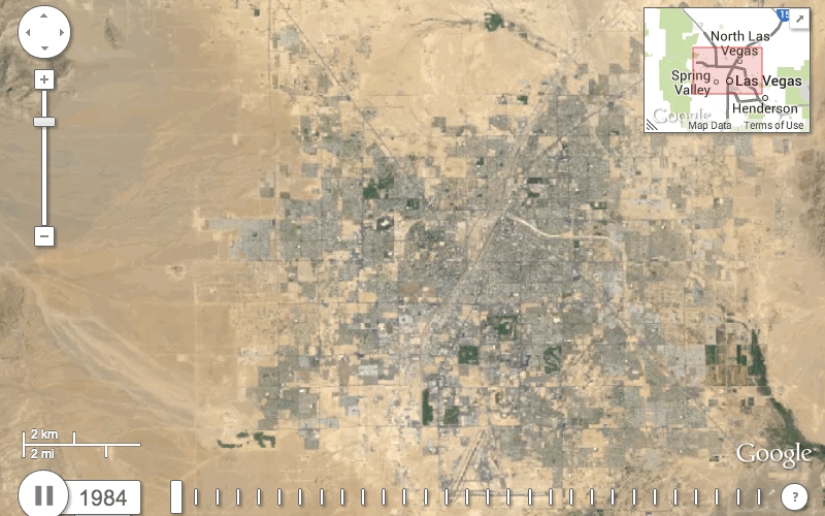
Urbanization of Las Vegas
Las Vegas, one of the five largest cities in the US, has seen a population growth of more than 40% between 2000 and 2010. As of 2010, more than half of all people on earth lived in rural areas. By 2030, six out of every 10 people will live in the city, and by 2050 already 7 out of 10 people. In absolute terms, the number of people living in cities will almost double by 2050.
Las Vegas, from the day it was founded, has been facing problems of lack of fresh water. Today, this problem is solved with a giant pipeline that diverts water from the Colorado River, providing almost 90% of the city's fresh water needs.
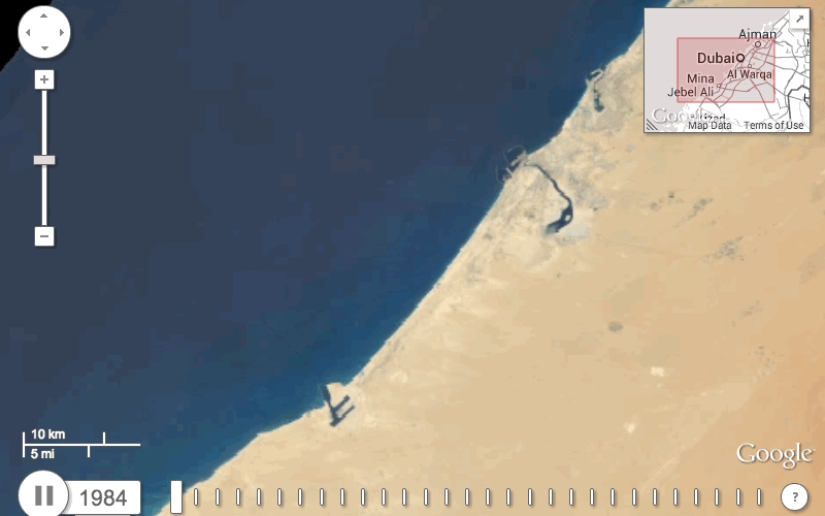
The rise of Dubai
The map shows the rapid development of Dubai's coastal region at the start of the 21st century. The Gulf countries as a whole have undergone rapid urbanization driven by windfall profits from oil production and sales. The states that are members of the Gulf Cooperation Council, which includes the United Arab Emirates, Bahrain, Saudi Arabia, Oman, Qatar, Kuwait, are experiencing rapid population growth. From 1990 to 2011, the population here more than doubled to 46 million people. Between 1995 and 2011, their combined GDP per capita more than tripled.
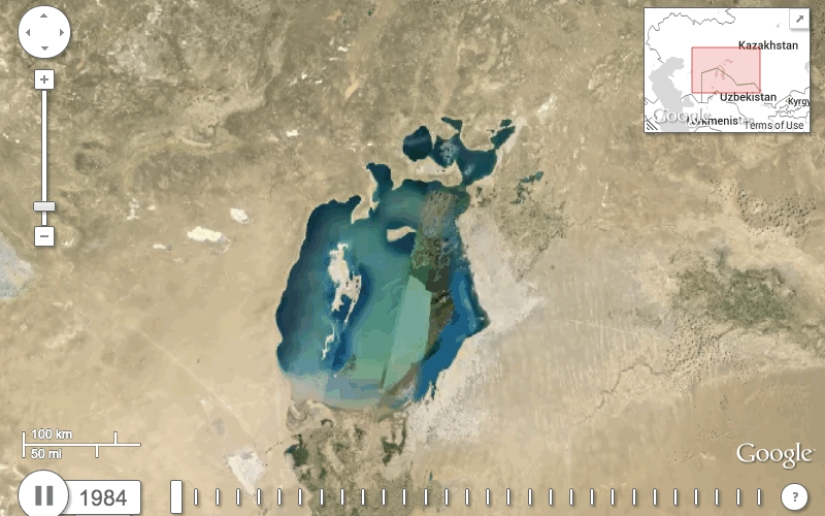
The catastrophe and the disappearance of the Aral Sea
The situation in the Kazakhstan Aral Sea is considered "one of the worst environmental disasters on the planet." The Aral Sea, formerly one of the world's four largest lakes, had virtually disappeared from the face of the Earth by 2012. In the early 1960s, Soviet politicians decided to irrigate the cotton-growing areas by diverting the waters of the Amu Darya and Syr Darya rivers from flowing into the Aral Sea. As a result of the cessation of water supply to the Aral Sea, as well as in combination with local climatic changes, an ecological disaster occurred.
The problem of the Aral Sea revealed another problem - the lack of drinking water on Earth. There are already 2.7 billion people lacking fresh water, which is about 40% of the world's population. Currently, one third of the world's rivers and groundwater are disappearing.
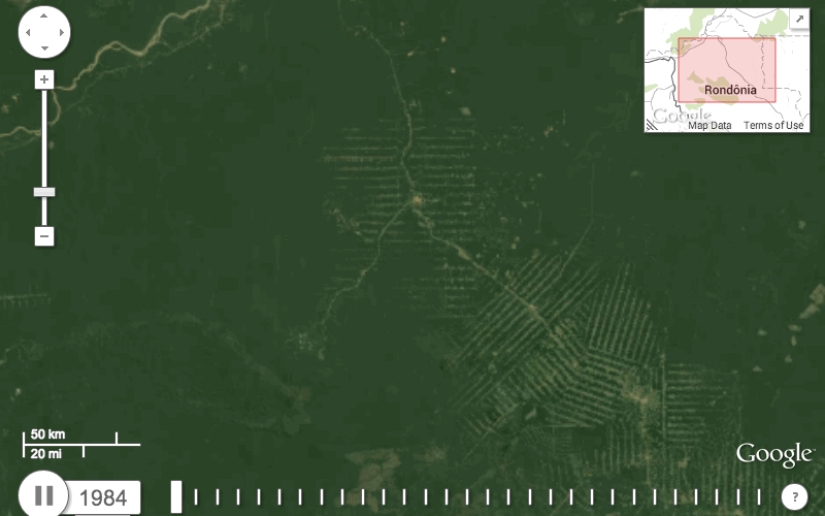
deforestation
From 1984 to 2012 Brazil has been ruthlessly deforested. In fact, over the past 50 years, 17% of the Amazonian forests have been deforested and disappeared largely due to land clearing for grazing. Forests cover 31% of the planet. They also provide 1.6 billion people with food, fresh water, clothing and traditional medicine ingredients. But between 46,000 and 58,000 square miles of forest is cleared annually, the equivalent of 36 football fields-sized forests disappearing every minute.
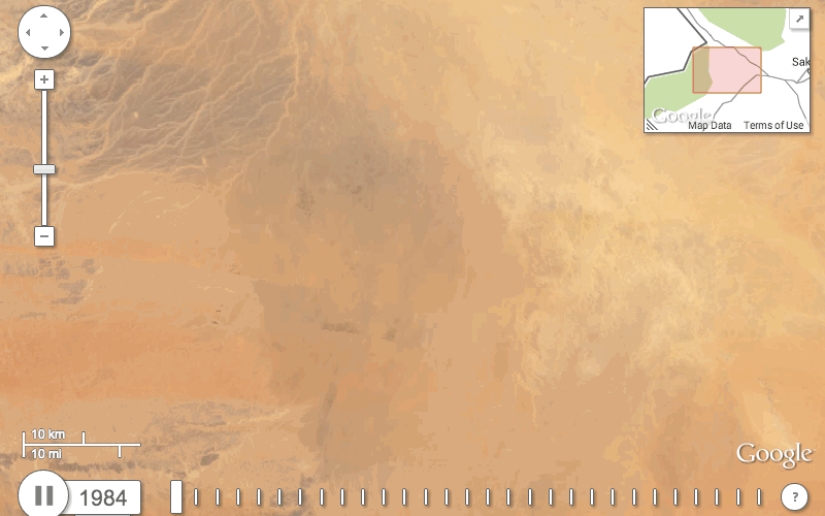
Irrigation
The picture shows an increase in irrigation area in Saudi Arabia. Green circles are areas of new agricultural land. Since the 1980s, the expansion of irrigated areas has lowered the world food price index. In 2005, approximately 300,000 ha were irrigated worldwide.
The largest number of irrigated areas is in Asia, approximately 70%.
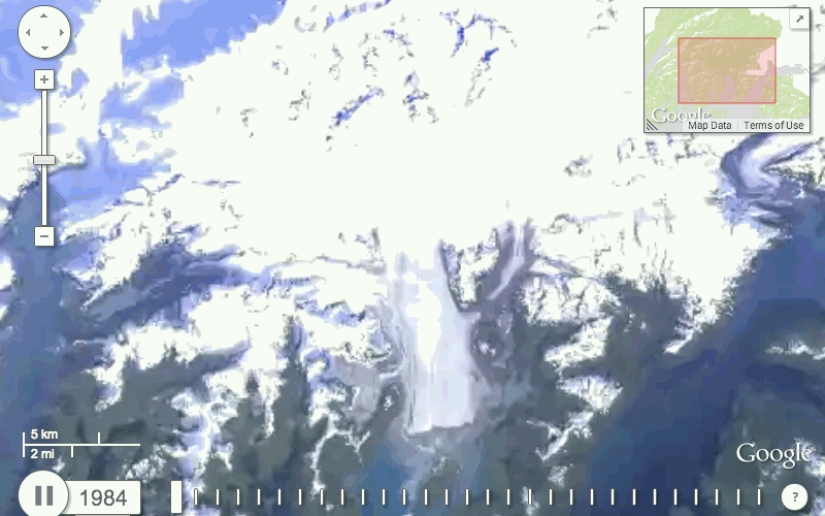
Retreat of glaciers
Pictured is the Columbia Glacier in Alaska. Since the 1980s, the glacier has lost half of its total thickness and volume. Scientists measure glacial deficits using mass balance, or the difference between accumulated snow in winter and subsequent melt at higher temperatures. Twenty of the world's largest glaciers, from Alaska to South America and Central Europe, are melting. Between 1980 and 2011, glaciers around the world lost about 15.7 meters of water equivalent. The melting of glaciers causes an increase in the level of the World Ocean and flooding of low-lying areas.
Keywords: Gif | Maps | Landscape
Post News ArticleRecent articles

It's high time to admit that this whole hipster idea has gone too far. The concept has become so popular that even restaurants have ...

There is a perception that people only use 10% of their brain potential. But the heroes of our review, apparently, found a way to ...
Related articles

If you like peace and privacy, it is unlikely that you will choose a metropolis, going on vacation. Especially when in the world ...

You felt it unpleasant feeling for you someone is watching? Or that someone is under your bed? This was inspired by Brian Coldrick, ...

How many amazing places holds our planet! The island of Lanzarote, part of the Canary Islands — one of those places. ...
New Year's is a time to surprise and delight loved ones not only with gifts but also with a unique presentation of the holiday ...