
Gay Bomb and Other Most Absurd Military Projects
Categories: History | Technology
By Pictolic https://www.pictolic.com/article/gay-bomb-and-other-most-absurd-military-projects1.htmlAs paradoxical as it may sound, war is the engine of progress. The military industry accumulates the best minds and the most advanced technologies. It also happens that in the race for an advantage over a potential enemy, engineers even overdo it, and their ideas end up on the verge of extreme progressiveness and absurdity. We will tell you about such projects.

In 1941, American dentist Lytel Adams had a very original idea. During a walk through Carlsbad Caverns, inhabited by a large colony of bats, he came up with the idea of using these animals as air bombs: attach miniature napalm bombs with a timer to them and release them at dawn over the cities of Japan. The mice would settle down for the night in attics and roofs (at that time, Japanese cities consisted mainly of wooden buildings), after which the timers would go off and a large-scale fire would begin.

Adams proposed the idea to the U.S. government, and First Lady Eleanor Roosevelt, who worked for the Office of Strategic Services, liked it. The project was approved, called X-Ray, and for a time became an important element of U.S. strategy in the Pacific theater.

Having caught tens of thousands of mice, the Americans began testing. During the very first experiment, when loading into containers, several individuals with bombs prematurely came out of hibernation and hid in wooden hangars, burning them to the ground. The car of the air base commander also burned. This incident was considered proof of the effectiveness of the experimental weapon.
According to the plan, ten bombers were to take off from Alaska and drop more than a million bats on industrial cities in Osaka Bay. Testing, however, was too slow, and when it became clear that such an air strike would not be possible before the summer of 1945, the project was canceled. It was decided to focus on nuclear weapons.

Thirty years before Star Wars, the Nazis were seriously working on a project called a sun gun, capable of incinerating cities, draining seas and burning enemy troops. They were based on the work of the Austro-Hungarian scientist Hermann Oberth, who in the 1920s proposed launching a giant mirror into Earth orbit to illuminate entire cities.
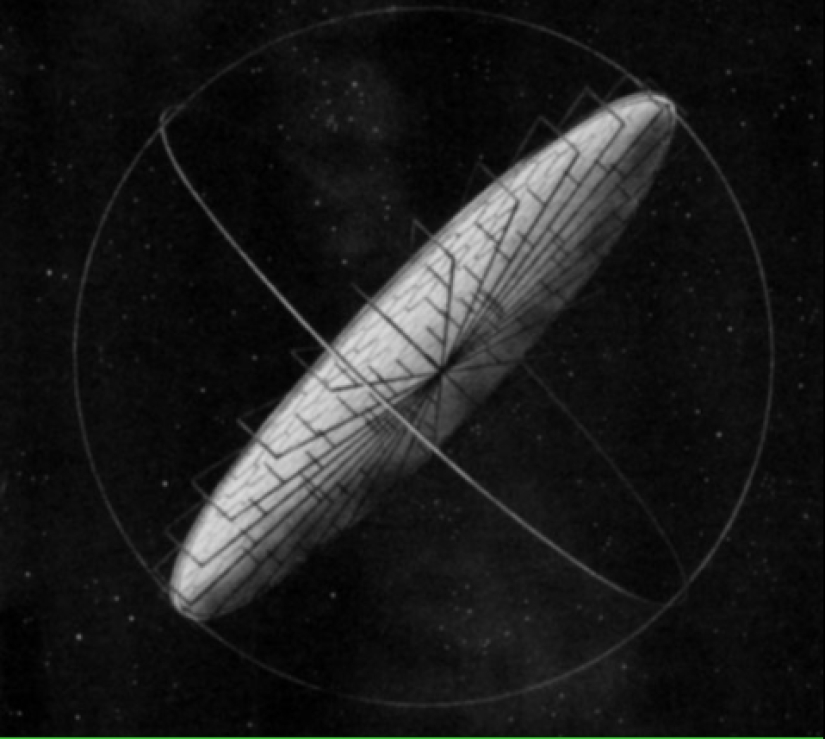
Experiments in outer space became hypothetically possible after the Third Reich got hold of V-2 ballistic missiles. The Germans conceived of hanging a mirror in orbit that would concentrate the sun's rays into one beam of incredible power. They planned to assemble the mirror directly in space in the following way: a rocket in orbit would rotate and unwind several metal cables that would eventually form a circle. After that, they planned to attach ready-made mirror modules to it.

The mirror was to be controlled by manned space stations, which would direct it to the required area. Electricity would be generated by steam engines installed at the stations, and oxygen would be generated by plants in greenhouses. The implementation of this crazy idea was, understandably, prevented by Germany's defeat in the war. However, the scope of the project was such that even today it would be difficult to implement it by the efforts of one country.
In 1994, the Pentagon announced a competition to develop non-lethal air-to-ground munitions. Specialists from a secret laboratory in Ohio responded with three brilliant ideas at once. First, they proposed dropping bombs on the enemy with a substance that causes severe and prolonged halitosis, that is, an unpleasant smell from the mouth. Another bomb was thought up to be filled with pheromones that attract bees and wasps so that they would sting the enemy until they completely lose combat readiness. And finally, the third project - the coolest one - was to "fill" the shells with powerful aphrodisiacs that cause the strongest sexual arousal, even homosexuality.

Information about this, so to speak, weaponry leaked to the press in 2004 and caused a scandal in connection with the possible violation by the United States of international conventions on the non-proliferation of chemical weapons. Gay activists were also outraged: they were offended by the assumption that homosexual soldiers have low combat effectiveness. In response to the accusations, the Pentagon stated that this idea was not developed.
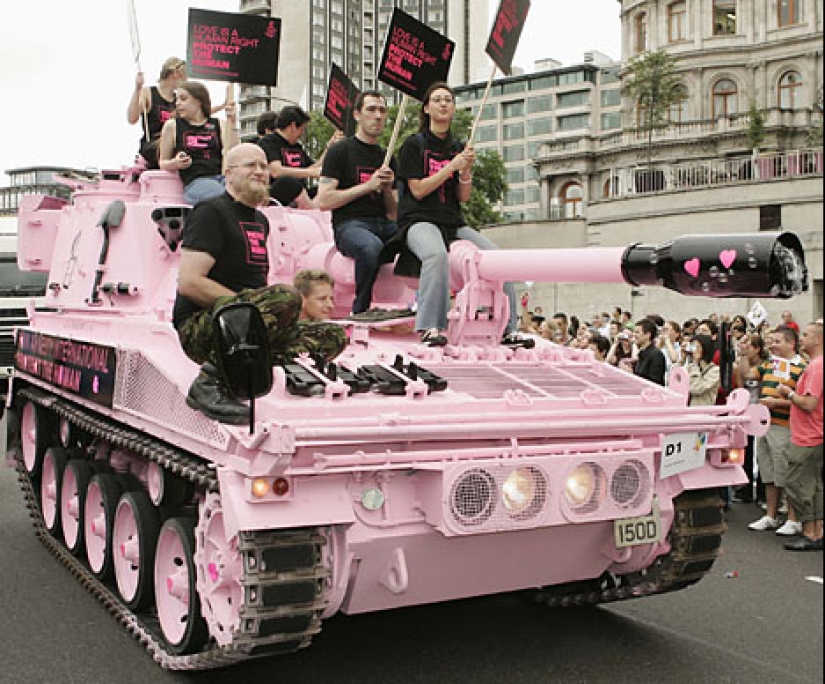
In 2007, the gay bomb won the Ig Nobel Prize, which is awarded for dubious achievements in science and technology. However, none of the invited American military officers showed up for the ceremony.


The British Strategic Operations Command also knew how to think big. At the beginning of World War II, an officer of this department, Geoffrey Peake, proposed building a ship, the sight of which would completely demoralize the enemy - an aircraft carrier two thousand feet long (609 meters). For comparison, the largest of the existing aircraft carriers - the American Enterprise - is 342 meters long. And, in order to make this colossus unsinkable, they decided to build it out of ice.
The project was named Habbakuk, after the biblical prophet Habakkuk, who said, "You will be amazed, for I am going to do in your days what you would not believe even if I told you." The ship was intended to serve as a floating base for aircraft tracking German submarines in the middle of the Atlantic. The structure was planned to maintain its temperature regime using thousands of kilometers of pipes with a circulating coolant. At the same time, the estimated speed of the giant was only six knots.
The idea of using ice was quickly abandoned and replaced with pykrete, a frozen mixture of water and sawdust. It was so strong that it repelled revolver bullets. But the project was closed after six months. The 18-meter model of Avvakum, built in Canada, took three years to melt.
Recent articles

It's high time to admit that this whole hipster idea has gone too far. The concept has become so popular that even restaurants have ...

There is a perception that people only use 10% of their brain potential. But the heroes of our review, apparently, found a way to ...
New Year's is a time to surprise and delight loved ones not only with gifts but also with a unique presentation of the holiday ...