
Camel Girl: The True Story of Ella Harper
Categories: History | Lifestyle | People | Photo project | Society | Tragedy | World
By Vika https://www.pictolic.com/article/camel-girl-the-true-story-of-ella-harper.htmlElla was born in 1870 in Tennessee, USA. She was born with a very rare genetic disease, due to which her knees were turned out the other way, and therefore she could only walk on all fours. This meant that her fate was sealed already at her birth - Ella got into the circus.
4 PHOTOS
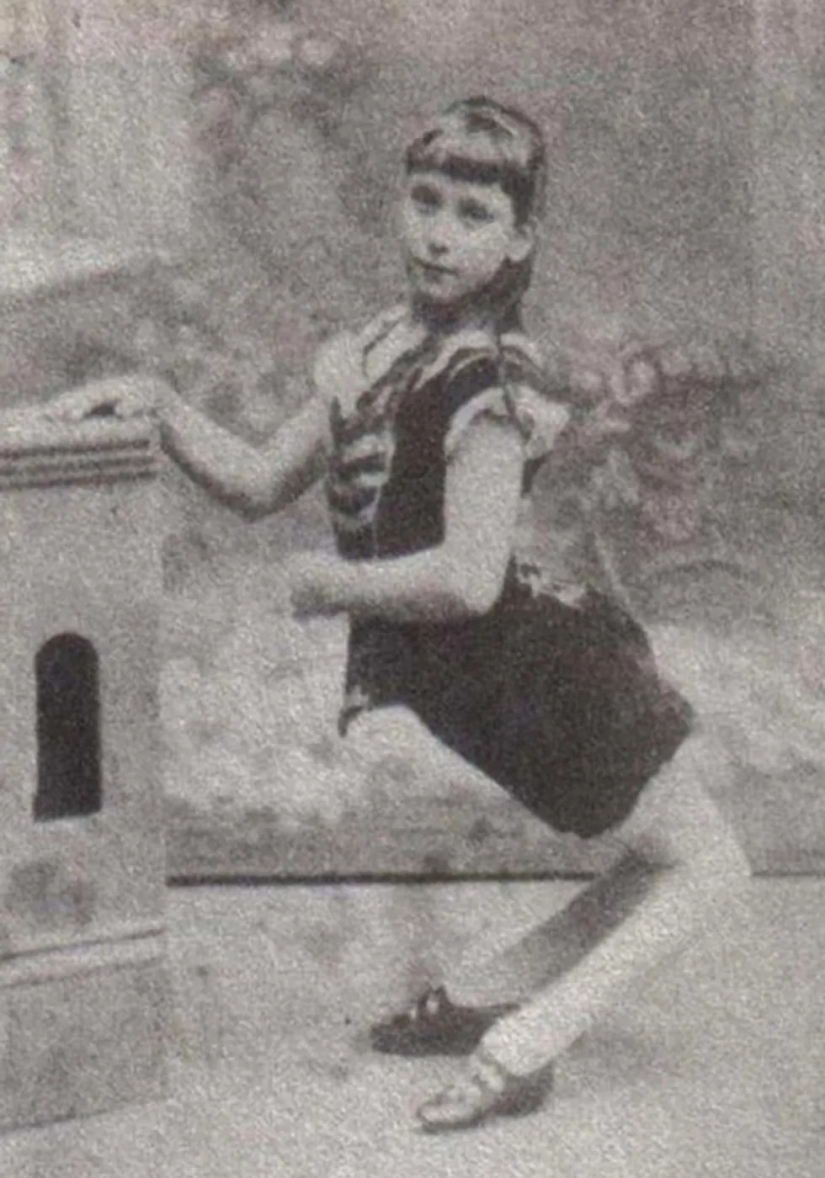
1. Ella was born to William and Minerva Harper in the small town of Hendersonville, Tennessee. The Harper family already had four children: three sisters and a brother. Ella was born together with her twin brother, who was named Everett, and her parents immediately noticed that something was wrong with their baby (or maybe with Everett - this is not known for certain). Her knees, instead of bending forward as most people do, bent in the opposite direction.
The disease is called recurvation of the knee joint. Unfortunately, over the years, the stability of people with this disease decreases, and often they can no longer hold firmly in an upright position, and therefore begin to move on all fours: palms and feet on the floor.
No one doubted that with such a rare defect, Ella had a direct road to the circus - oddly enough, it was the circus that could give her a start in life. At the age of 12, she began touring the country with the Harris' Nickle Plate show, which included not only acrobats and elephants but also people with unusual appearances. Ella began to be paid about $200 a week, which was equivalent to today's $5,000. A lot of money!
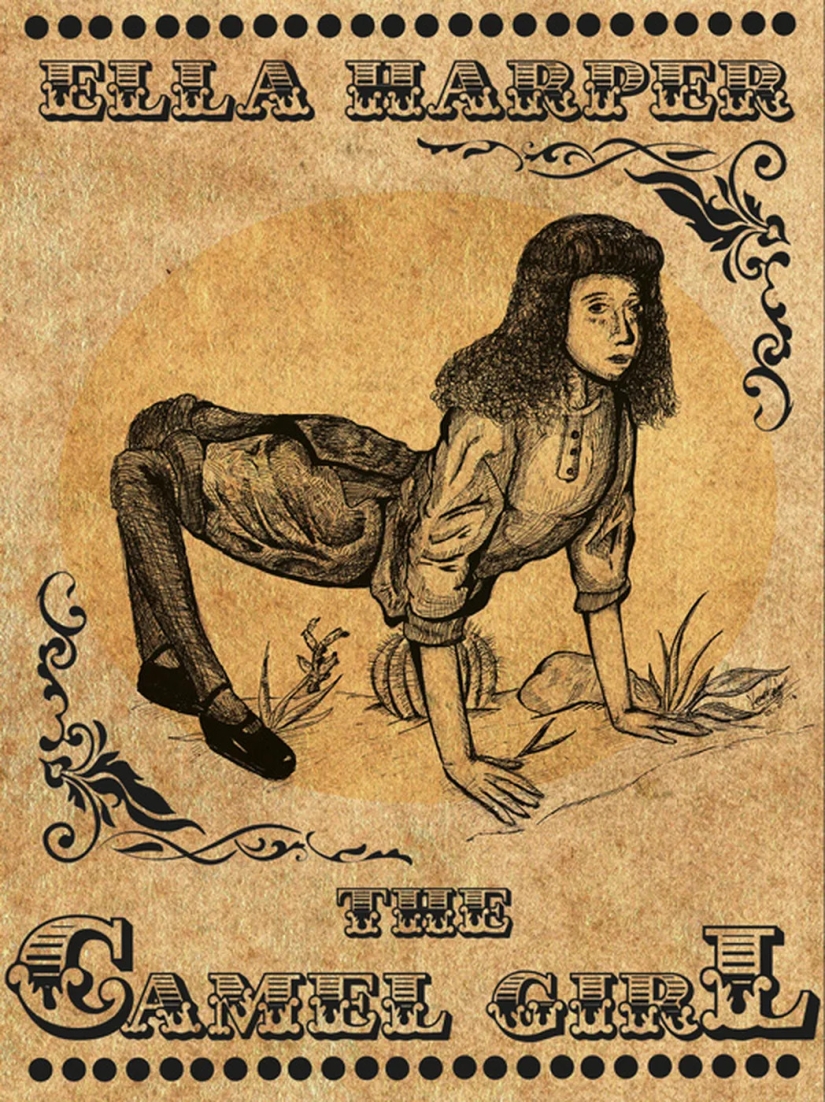
2. During the tour, Ella received the nickname "camel girl" - that's what the audience began to call her, they also began to write on advertising posters in order to attract as many visitors as possible. She was written about as an attractive young lady who had body parts and a camel-like gait.
Probably, Ella played into the hands of precisely the fact that outwardly she really was quite pretty: the combination of a pleasant face and an unusual gait created a sharp contrast and attracted attention.
In 1886, Ella took part in a photo session with the famous New York photographer Charles Eisenmann, who specialized in photographing people with pronounced physical disabilities. For now, these photographs remain the last known images of Ella.
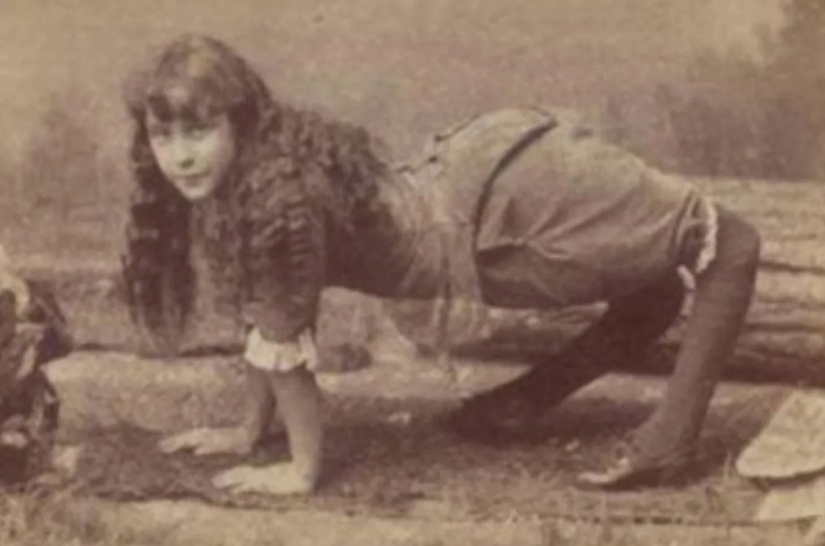
3. Later, tired of traveling, the girl left the show, while earning good money. She commented on her departure as follows: “They called me the camel girl because my knees were turned out the other way. I can only walk on my hands and feet at the same time, which you can see in the photo with me. I have traveled a lot in the past four years doing shows, but now in 1886, I intend to leave show business and go to school. I would like to change my occupation."

4. In 1903, Ella and her mother moved to Nashville, the state capital. Just two years later, Ella unexpectedly married schoolteacher Robert Savely. A year later, their daughter was born, but, unfortunately, she died very soon. They probably tried to have more children but to no avail. Then they adopted a girl from an orphanage named Jewell. But here, too, grief befell the spouses - the baby suddenly died at three months.
Ella also died in 1921 from colon cancer. She was buried in Nashville at Spring Hill Cemetery, next to her children.
Keywords: Camel girl | History | People | Interesting people | True story | Life | Appearance | Genetic disease
Post News ArticleRecent articles

It's high time to admit that this whole hipster idea has gone too far. The concept has become so popular that even restaurants have ...

There is a perception that people only use 10% of their brain potential. But the heroes of our review, apparently, found a way to ...
Related articles

In the fall of 1972, Bill Yates traveled through the countryside in the vicinity of Tampa, Florida. At that time, he was studying ...

When a person is in a life-threatening situation is awful, but even worse when it happens to a child. 11-year-old American Terry ...

This is an amazing photo project of Mike Harvey: it takes people in his car, and photographs them at the same time, we are about to ...
New Year's is a time to surprise and delight loved ones not only with gifts but also with a unique presentation of the holiday ...