
Beer Love Post: how to cook a real " Guinness»
Categories: Europe | Food and Drinks | History
PictolicIn 1759, the Irish brewer Arthur Guinness signed a lease for an abandoned brewery at St James ' Gate in Dublin. The annual rent was 45 pounds, and the lease term was 9,000 years.
At first, only ale was brewed, the business brought a good income. The first batch of Irish beer was exported to England 10 years after the signing of the contract. In 1799, after noticing that Dublin porters preferred a pint of dark beer to ale, Guinness decided to refocus production. The variety got its name thanks to the people for whom it was brewed — porter (from the English word "porter" - loader). A few years later, Arthur Guinness ' porter became a world-famous stout.

At the turn of the XIX-XX centuries, the company began to hire scientists who developed new brewing technologies. The chemist Alexander Forbes-Watson founded a research laboratory in St. James ' Gate, which was soon followed by an experimental brewery.
In August 1953, a Picture Post photographer was able to get into the holy of holies of all beer lovers. At that time, the Guinness brewery was considered the largest in the world, producing 80% of the total volume of hoppy drinks in the country. These photos show a sacred process in which water, malt, barley, hops and yeast were crushed, mixed, boiled, fermented and filled with barrels branded with the canonical Irish drink.

Henry Barter relishes lighting his pipe after downing a pint of Guinness at John Mullet's Pub in Dublin.

Eugene Hackett leaned on the cart that was used to transport malt around the brewery grounds.

Workers at the brewery.

A worker drags a bag of malt to the warehouse.

Assembling a new barrel. Later, it will be filled to the brim with hoppy Guinness.

Joe McCarthy burns the assembled barrel.

The worker sews special covers that served as protection for beer barrels during transportation.

A worker cleans the chute so that the remaining hops do not get into the wort boiler.

Workers drain the beer from the boiler.

Cleaning the wort vat.

A brief respite before the man continues to clean the wort vat again.

In this huge "pool", the yeast foam was removed from the beer before the drink was sent to another vat.

A worker oversees the cleaning of beer from the foam.

In a special workshop, barrels were scalded from rubber hoses.
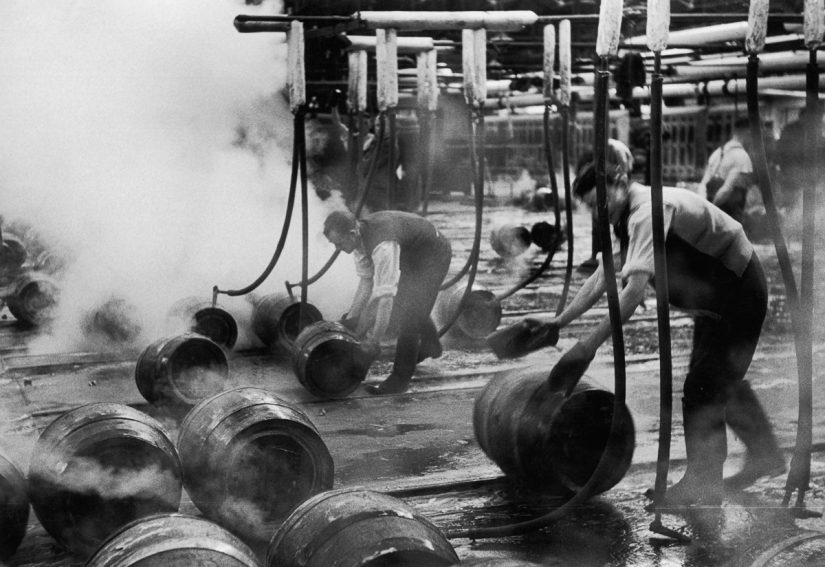
The scalded barrels are rolled to the next shop.

Paddy Farrell rolls out the finished barrels.

James Mayer brands the container with the company logo.

A special "sniffer" checks the quality and cleanliness of the barrels.

Here, ready-made cups were filled with beer.


A worker rests with his foot on a barrel full of ale.

Henry Barter enjoys another pint of the legendary Guinness stout.
Keywords: Europe | History | Beer | Process | B / w | Brewing | Food and drink
Recent articles

It's high time to admit that this whole hipster idea has gone too far. The concept has become so popular that even restaurants have ...

There is a perception that people only use 10% of their brain potential. But the heroes of our review, apparently, found a way to ...
Related articles

In the fall of 1972, Bill Yates traveled through the countryside in the vicinity of Tampa, Florida. At that time, he was studying ...

When a person is in a life-threatening situation is awful, but even worse when it happens to a child. 11-year-old American Terry ...

Remember how broke the "unbreakable" scoop? The photo preserved in the photo album of almost every family! A selection of vintage ...
New Year's is a time to surprise and delight loved ones not only with gifts but also with a unique presentation of the holiday ...